

20 Surgical Instruments Every Surgeon Must Know
- 1 day ago
- 7 min read
The operating room is a high-stakes environment where a fraction of a millimeter separates an elegant outcome from a grueling complication. As a surgeon, your hands are only as good as the steel you hold. To truly master the craft, you must understand that an instrument isn't just a tool. It is an extension of tactile awareness.
Medical sourcing requires looking past standard catalog descriptions to understand how instruments perform under tension. Here is the insider breakdown of 20 essential surgical instruments, stripping away the textbook definitions to reveal how they actually behave in a surgeon's grip.
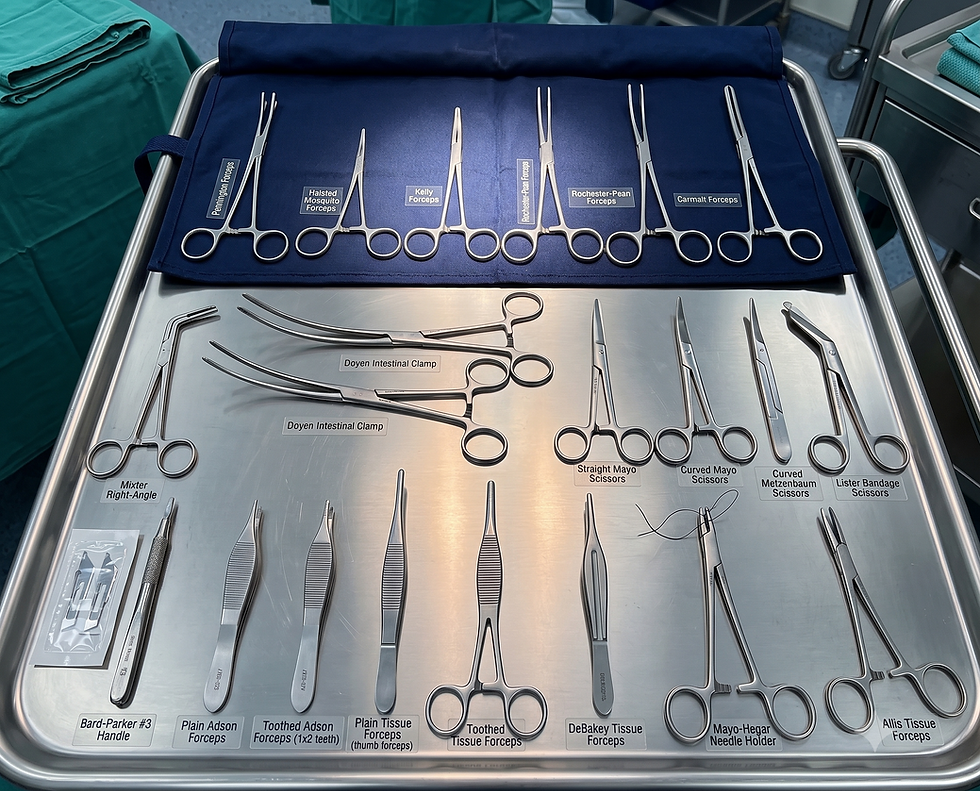
Click instrument name for more details.
The textbook says these grasp tissue or hold drapes. That label is misleading. The defining feature here is the triangular, open jaw design with serrated tips. Experienced surgeons prize the Pennington for its ability to securely hold tissue without crushing it into the center. Tissue bulges comfortably into the triangular window, minimizing ischemic necrosis. It is a staple in OB/GYN and rectal surgeries where you need a firm, non-slip grip on robust, highly vascular tissue walls.
These are designed to clamp small, superficial bleeders. They are the delicate sports cars of the hemostat family. Because they are engineered for micro-volumes, a common rookie mistake is trying to clamp a massive, deep arterial bleeder with them. That error leads to a sprung hinge or a torn vessel. A skilled surgeon can control a field with just a few well-placed mosquitos and minimal electrocautery, preserving delicate dermal tissue margins for pristine scarring.
Junior residents frequently confuse the Kelly with the Crile clamp. The differentiator is simple: Kelly forceps only have serrations on the distal half of their jaws. The proximal half near the hinge is completely smooth. This design allows you to slip the clamp under a vessel or bundle without the teeth catching and tearing neighboring tissue prematurely. It is the definitive choice for mid-sized bleeders where precision and blind-sliding co-exist.
When you need raw, uncompromising mechanical advantage, you ask for a Rochester-Pean. Unlike the Kelly, these jaws feature heavy, fully transverse serrations running all the way down to the box lock. They are bulky, heavy-duty, and designed to crush or completely occlude large vascular pedicles like a uterine or splenic ligament. When it bites, it does not let go. This makes it a crucial tool for securing absolute hemostasis before a major transection.
At first glance, it looks like a standard heavy clamp. Look closer at the jaw geometry. Carmalt forceps feature longitudinal striations running the length of the jaw, ending in a small cross-hatched pattern at the very tip. This longitudinal design acts like a track system that prevents large tissue bundles or thick blood vessels from slipping out of the front of the clamp when squeezed tight. If you are dealing with a thick, slippery pedicle, a longitudinal Carmalt is infinitely safer than a transverse clamp.
Commonly referred to in the theater simply as a right angle. The severe curve of the jaw allows you to navigate completely underneath a hidden structure, like the cystic duct or a deep artery, without sacrificing your visual line of sight. The real utility lies in a technique called snapping and passing. You clip a long silk suture thread into the very tip of the Mixter, blind-slide it behind the vessel, pop open the jaw to release the suture on the other side, and easily tie off a deep vessel you can barely see.
Bowel surgery requires a fine balance. You must temporarily block the flow of enteric contents without destroying the delicate mesenteric blood supply of the gut wall. The Doyen achieves this via highly flexible, long, thin blades featuring fine, shallow longitudinal serrations. When locked on the lowest ratchet step, the metal flexes slightly, acting like a gentle spring rather than a vice. It holds the bowel closed but keeps the tissue alive.
For an even more sophisticated level of tissue preservation, the Carter-Glassman takes atraumatic clamping further. If you examine the high-definition profile of the jaw, you will notice a specialized, finely patterned dual-surface grip designed to distribute pressure completely evenly across a delicate, fluid-filled intestinal loop. It provides lateral stability so the bowel does not twist out of the clamp, making it a favorite in advanced gastroenterology workflows.
Straight Mayo scissors are strictly for cutting materials, sutures, and tough, fibrous connective fascial planes. Never use them on fine, delicate tissue. Because of their heavy-gauged construction, they retain a robust cutting edge capable of slicing through thick synthetic meshes or heavy polypropylene knots without twisting or dulling the blades.
While the straight counterpart cuts structural materials, the curved Mayo is your heavy-duty tissue dissector. The graceful upward arc allows the surgeon to gain visibility and follow natural anatomical contours, slicing through tough deep fascia, linea alba, or dense scar tissue. A classic senior maneuver during a re-operation is using the blunt outside edge of the closed curved blades to push away surrounding tissue planes before executing a clean cut.
Known affectionately as the Metz, these are the instruments of precise, fine dissection. They feature long, slender shanks and short, relatively small blades. The golden rule of the operating room is simple: never, under any circumstances, cut sutures or dressings with the Metz. Doing so immediately ruins their razor-sharp, micron-matched alignment, turning an elegant instrument for separating delicate mesenteric windows into a jagged tissue-shredder.
The defining feature is the smooth, blunt, bulbous tip on the lower blade. This design allows you to slide the blade flat against a patient’s skin underneath tight bandages, casts, or sheets without any risk of gouging or puncturing the skin. The offset angle of the handle keeps your fingers elevated and away from the body wall, maximizing cutting leverage while speeding up emergent debridements.
This is the industry standard for cold knife surgery. A flat #3 handle typically hosts #10, #11, and #15 blades. The real technical artistry lies in the grip style. Surgeons use a pencil grip for tiny, high-precision dermatological or pediatric cuts, and transition to a palmar table knife grip where the index finger sits firmly on the top serrations to transmit smooth, steady downward pressure for long, clean laparotomy incisions across the abdominal wall.
These wide-bodied, fine-tipped pickups are designed for the final stages of a procedure. Because they are plain, meaning they feature fine cross-serrations rather than interlocking teeth, they are optimal for handling dressings, packing sponges, or stabilizing delicate adventitial sheaths without ripping them apart. Squeezing too hard to grip slippery fascia or thick dermis with plain Adsons will cause crush injuries on the tissue margins.
Counterintuitively, the tiny interlocking teeth, typically a 1x2 configuration, are safer for delicate skin closure than plain forceps. Because the sharp teeth securely hook into the tissue with minimal pressure, you do not have to squeeze the handle tightly to prevent slippage. This preserves microvascular capillary flow at the wound edge, leading to vastly superior healing profiles and clean, flat closure lines.
These are your standard thumb forceps. They are long, ribbed instruments intended to reach deeper into a cavity where a compact Adson cannot go. General surgeons rely on them heavily to stabilize structures during deep bowel resections or to hold fine suture threads during a continuous running stitch where catching a tooth on the needle or suture loop would break the fluid tension.
When you are handling dense, slippery structures like muscle sheaths, plantar fascia, or thick scar tissue, you need a full-sized toothed pickup. The robust interlocking teeth dig deep into the fibrous material, allowing the surgeon to pull heavy structural layers together with absolute mechanical security. It is the definitive workhorse for the fast, rigorous closing of deep surgical layers.
Invented by cardiovascular pioneer Dr. Michael DeBakey, this instrument is a design masterpiece. The jaw features a uniquely shallow, longitudinal channel lined with microscopic, interlocking transverse teeth. This distributes the pressure completely over a wide surface area, letting you securely grip highly vulnerable arteries, veins, or nerves without causing intimal tearing or endothelial damage. If you are working near major plumbing, you want a DeBakey in your non-dominant hand.
An experienced surgeon knows that the Mayo-Hegar is the gold standard for structural closure. It features a cross-hatched, diamond-cut internal jaw profile, frequently reinforced with Tungsten Carbide inserts, designed to clamp the body of a curved needle and prevent it from rotating or twisting mid-bite through dense tissue. Listen for the double-click on the ratchet mechanism. That sweet spot provides perfect structural tension to freeze a heavy #1 or 0 Prolene needle in place without structurally flattening or weakening the needle wire itself.
The Allis clamp is a marvel of surgical geometry, recognized by its distinct, interlocking teeth that form a box-like mouth at the tip. Because it exerts highly focused structural pressure, treat it as a semi-traumatic clamp. You never use it on fragile, highly vascular tubular organs like the bowel or a major artery unless that specific section is being resected from the body. Instead, it is the premier tool for gripping slippery, tough fascial planes or tumor margins during a dissection, giving you the maximum possible mechanical leverage to retract dense tissue layers apart under tension without slipping.
Surgical outcomes depend entirely on the predictability, tactile feedback, and structural integrity of these instruments. Procurement directors and healthcare distributors cannot afford to treat surgical steel as a basic commodity. Substandard manufacturing leads to scissor blades that slip, needle holders that let wires twist, and clamps that compromise tissue viability.
There are literally thousands of instruments, but in each general surgery OR, you will probably come face to face with these 20 surgical instruments every surgeon should know.
To find these and other instruments in the best quality, consider Dr. Frigz Instruments. Dr Frigz manufactures surgical, dental, and electrosurgery instruments engineered to meet these exact clinical realities. By partnering with Dr. Frigz, your institution gains access to world-class manufacturing, rigorous quality control, and instruments designed to feel like a natural extension of the surgeon's hand. Contact our team today to explore global distribution and sourcing partnerships.


Comments