

Technical Standards for Surgical Forceps: A Procurement Guide
Surgical forceps serve as the primary extension of a surgeon's hand. These grasping, holding, and clamping instruments are essential in every surgical discipline, from general operations to specialized microsurgery. Their design directly influences tissue handling precision, procedural efficiency, and patient outcomes. For procurement managers and hospital supply chain directors, selecting the correct forceps involves evaluating metallurgical integrity, ergonomic geometry, and strict adherence to international regulatory standards.

Clinical Taxonomy and Variations
Forceps are classified by their functional intent, which dictates their structural design:
Thumb Forceps (Non-locking): Designed for tissue manipulation, grasping, and suturing. Available with serrated tips for delicate tissue or "toothed" (e.g., 1x2 teeth) configurations for secure traction on tougher structures.
Hemostatic Forceps (Locking): Feature a ratchet mechanism to provide continuous clamping pressure on vessels. The curved variant provides enhanced visibility in deep cavities, while straight patterns are optimized for superficial work.
Tissue Forceps: Feature specialized designs such as DeBakey patterns, which incorporate longitudinal serrations to provide a secure grip with minimal traumatic impact on delicate vascular tissue.
Material Science and Standards for Surgical Forceps
Surgical instruments must withstand repeated exposure to chemical cleaning agents and high-temperature autoclaving. Material selection is governed by international consensus to ensure corrosion resistance and structural longevity.
Compliance Standards:
ASTM F899: Standard Specification for Wrought Stainless Steels for Surgical Instruments.
ISO 7153-1: Surgical instruments—Metallic materials—Part 1: Stainless steel.
Material Grade Comparison
Material Grade | Application | Key Characteristic |
Martensitic (400 Series) | Cutting/Locking tools | High carbon content allows for hardening to high Rockwell C (HRC) values. |
Austenitic (300 Series) | Non-locking/Handles | Superior corrosion resistance but cannot be heat-treated for edge retention. |
Titanium Alloy | Specialized surgery | Lightweight, non-magnetic, and exceptional biocompatibility. |
Design Logic and Efficiency
The geometry of forceps is engineered to minimize mechanical fatigue and maximize visual clarity. Ergonomic handle tension is calibrated to provide tactile feedback without requiring excessive grip force. Anti-glare satin finishes are standard, reducing light reflection during high-intensity operating room lighting.
Procedures Requiring Specialized Forceps:
Vascular Anastomosis: Requires fine-tipped DeBakey forceps to manage vessel walls without endothelial damage.
General Tissue Dissection: Relies on standard thumb forceps for rapid tissue retraction.
Laparoscopic Surgery: Utilizes insulated, long-reach forceps for interior manipulation through trocars.
Failure Analysis
Proactive identification of instrument failure prevents intra-operative complications.
Tip Misalignment: Often caused by excessive force or dropping. If the tips do not meet flush, the instrument fails to grasp tissue reliably.
Pivot Stiffness: Accumulation of bioburden in the box lock restricts movement. This necessitates immediate deep cleaning or ultrasonic reprocessing.
Crevice Corrosion: Visible as pitting or discoloration near the pivot point. This indicates failure of the passivation layer and requires immediate retirement of the device.
Key Performance Features
Hardness Range: 40–50 HRC for standardized steel components to ensure stiffness without brittleness.
Surface Finish: Electropolished to achieve a surface roughness (Ra) of <0.8 µm, preventing bio-adhesion.
Tension: Consistent spring-back force for thumb forceps to reduce hand fatigue over extended procedures.
Lifecycle Management (IFU)
Effective instrument lifecycle management reduces total cost of ownership:
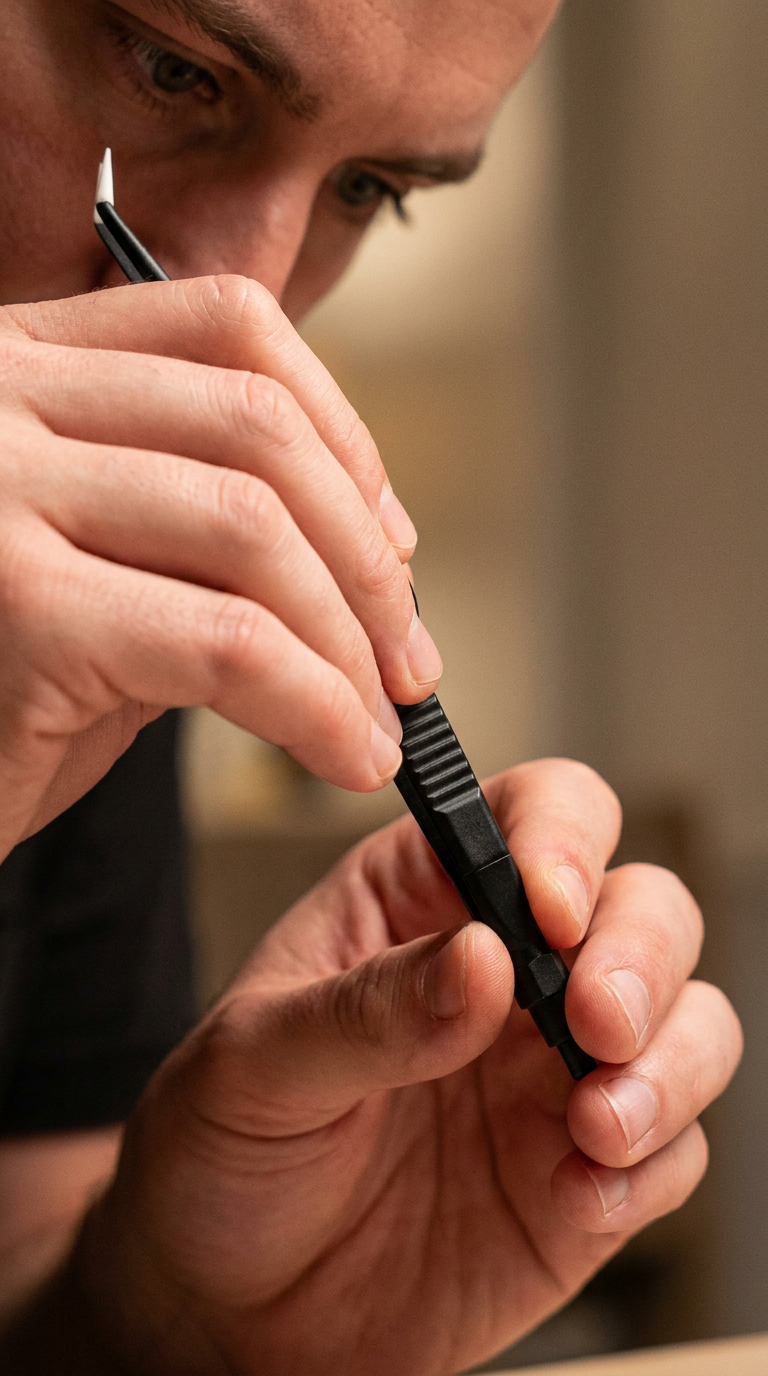
Pre-use: Inspect tips for alignment and box locks for smooth action under magnification.
Intra-operative: Avoid using saline for soaking, as chloride ions promote pitting corrosion in stainless steel.
Sterilization: Use enzymatic detergents with neutral pH. Ensure proper positioning in sterilization trays to prevent stress on tips.
Buyer’s Checklist
Does the manufacturer provide a Certificate of Origin and material traceability logs?
Is the instrument hardness verified within the specified HRC range?
Does the supplier offer validation reports for ISO 13485 and EU MDR compliance?
Can the supplier provide a breakdown of the metallurgical composition per ASTM F899?
Why Choose Dr. Frigz
With 46+ years of manufacturing expertise, Dr. Frigz provides precision instrumentation that meets the highest global standards. Our operations are fully certified under SA8000, ISO 13485, FDA, and EU MDR guidelines. We control the complete production lifecycle from initial forging to final sterile kit packing, ensuring uncompromising quality control for healthcare importers and hospital networks.
Visit www.drfrigz.com to request our current catalog or to obtain a comprehensive quote for your facility.


Comments