

How to Clean Surgical Instruments: Step-by-Step Decontamination Protocol
- 4 days ago
- 3 min read
Cleaning vs. Sterilization: The Hidden Foundation of Surgical Instrument Reprocessing
There is a common misconception in surgical instrument reprocessing: that sterilization is the critical step and cleaning is a formality. The reality is precisely the opposite. Sterilization without adequate prior cleaning is unreliable and potentially dangerous. Organic matter, including blood, protein, tissue debris, and lubricants, physically shields microorganisms from sterilizing agents, absorbs heat energy in autoclave cycles, and in some cases (notably prions) is completely resistant to standard sterilization methods regardless of temperature or duration. Cleaning is not a formality. It is the foundation that all sterilization effectiveness rests on.
The decontamination protocol begins at the point of use, right in the operating room immediately after the instrument has been used. Point-of-use care means removing gross contamination with a moist sterile towel before blood and tissue dry onto the instrument surface. Dried protein is significantly harder to remove than fresh contamination; an instrument left uncleaned for even thirty minutes after use is meaningfully more difficult to reprocess. Box locks should be kept open during transport to prevent debris from drying in the joint. Instruments should never be left immersed in saline solution at the point of use. Saline is highly corrosive to stainless steel and will accelerate pitting and corrosion even in premium-grade martensitic instruments.
On arrival at the CSSD, instruments are sorted and inspected for damage before entering the cleaning process. Damaged instruments that cannot be cleaned effectively should be flagged for repair or disposal before cleaning, not after. Instruments with joints should be opened fully, and any detachable components disassembled.
Pre-soaking follows. Instruments are immersed in enzymatic detergent at the manufacturer's recommended concentration and temperature, typically 35 to 45°C, for a minimum contact time of two to five minutes. Enzymatic detergents contain protease, amylase, and lipase enzymes that actively break down protein, starch, and fat residues. Generic detergents without enzymatic activity are insufficient for surgical instrument reprocessing.
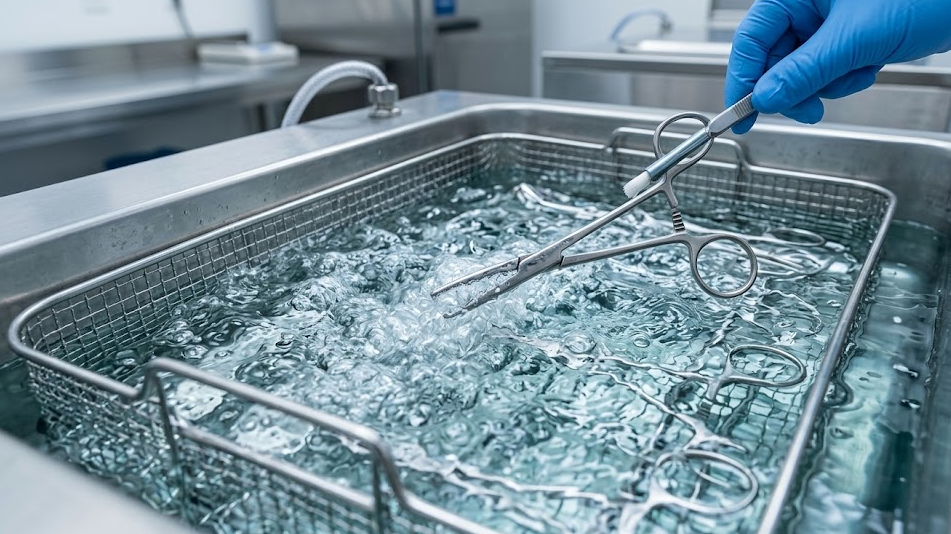
Manual cleaning is the most labor-intensive and most critical stage. Every surface of every instrument must be physically scrubbed with a soft-bristle brush, never a wire brush, which damages the surface finish. Special attention goes to box lock hinges and arm serrations, jaw serrations and teeth, ratchet mechanisms, and any crevices around screw attachments or ring handles. Irrigation syringes flush hollow lumens in cannulated instruments. Ultrasonic cleaners offer a powerful adjunct, using high-frequency sound waves to dislodge contamination in areas that brushes cannot reach. Automated washer-disinfectors are the gold standard for high-volume CSSD operations, combining enzymatic wash cycles, thermal disinfection at 90 to 93°C, and drying in a single validated process per ISO 15883.
Post-cleaning inspection is non-negotiable. Every instrument must be visually inspected under good lighting, preferably with magnification, for residual contamination, corrosion, and functional integrity. Protein residue test kits provide a rapid chemical check for residual organic matter. Instruments that fail inspection must be re-cleaned or removed from service before sterilization.
At Dr. Frigz, we design our instruments with reprocessing in mind from the outset. Open box lock geometries allow full access for cleaning brushes. Smooth passivated surfaces minimize the crevices where contamination accumulates. Consistent surface finishes meet the roughness standards that cleaning validation protocols require. Well-designed instruments are not just easier to clean; they are easier to inspect, easier to validate, and easier to maintain through hundreds of reprocessing cycles. Contact Dr. Frigz to request instrument specifications or to discuss custom OEM designs optimized for your facility's reprocessing protocols.


Comments