

Why Your Surgical Instruments Aren't Made by Robots
When healthcare distributors and industry partners walk through the doors of the Dr. Frigz manufacturing facility for the first time, they often arrive with a common misconception. Many assume that modern manufacturing is a simple, automated affair and that we press a few buttons, and a finished surgical instrument emerges from the other side.
It takes only a few minutes on our factory floor to dismantle that myth. Watching the faces of our partners as they see the reality of our operations is one of the most rewarding parts of what we do. They walk in expecting automation; they walk out with a profound respect for the human craft and technical rigor required to build the tools that surgeons rely on.
Here is what surprises people most when they witness the Dr. Frigz process firsthand.

1. It’s Not Just a Machine, It’s also another 40+ Steps
The most immediate shock for visitors is the sheer complexity of the workflow. Producing a single high-quality surgical instrument isn't a singular event; it is a journey involving 40 or more distinct processes and sub-processes.
From raw material selection to the final passivating bath and EO sterilization, every instrument undergoes a rigorous sequence of transformations. Our visitors are often stunned to realize that our facility is not just a factory, it is a symphony of metallurgical engineering, chemical process, precision machining, and specialized finishing. Its a dozen specialized factories combined in one.
2. The Human Touch is Irreplaceable
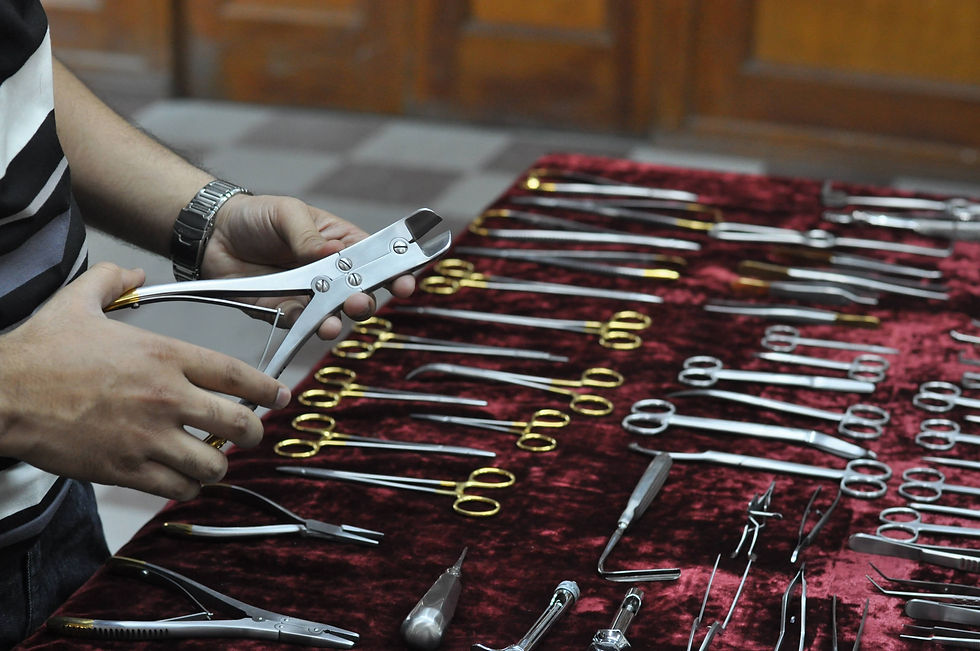
In an era of mass production, people are often surprised to see how much of our work is done entirely by hand or finished by hand after machining.
Whether it is the fine-tuning of a box lock, the meticulous sharpening of a blade, or the delicate adjustment of a tension spring, the human eye and the steady hand remain our most important tools. Machines provide the structural integrity, but our master craftspeople provide the "feel" and functionality that a surgeon needs to perform their best work.
3. The World of Chemistry and Precision
Many visitors aren't prepared for the sheer volume of chemical processing integrated into our production. We take them through various stages of liquid nitrogen quenching, electropolishing, and passivation; processes essential to ensuring that our stainless steel meets the highest medical-grade standards for corrosion resistance and biocompatibility.
Furthermore, they see the incredible level of documentation that accompanies every batch. In medical manufacturing, if it isn’t documented, it didn’t happen. The traceability we maintain is as technical as the production itself.
4. Why 1mm (and Even Smaller) Matters
How do we maintain quality across a production volume of 20,000+ instruments per month? Through the relentless reduction of process variation.
We show our partners how we inspect for the things they might never notice. Things like a sub-millimeter variance in a jaw alignment or a microscopic crack invisible to the naked eye. To a layperson, these details seem invisible. To a surgeon, they are the difference between a successful procedure and a critical failure. Seeing our inspection teams catching these minute imperfections with specialized equipment is a "wide-eyed" moment for many.
The Dr. Frigz Commitment
When you pick up a Dr. Frigz instrument, you aren't just holding a piece of medical equipment. You are holding the result of dozens of experts, hundreds of hours of combined labor, and a culture that refuses to accept "good enough."
To our distributors and healthcare partners: thank you for the trust you place in us. If you haven't visited us yet, we invite you to come see the process behind the performance. Come walk the floor, meet the team, and see exactly what it takes to turn raw steel into a masterpiece of surgical precision. Book your factory tour today.


Comments